
Vision
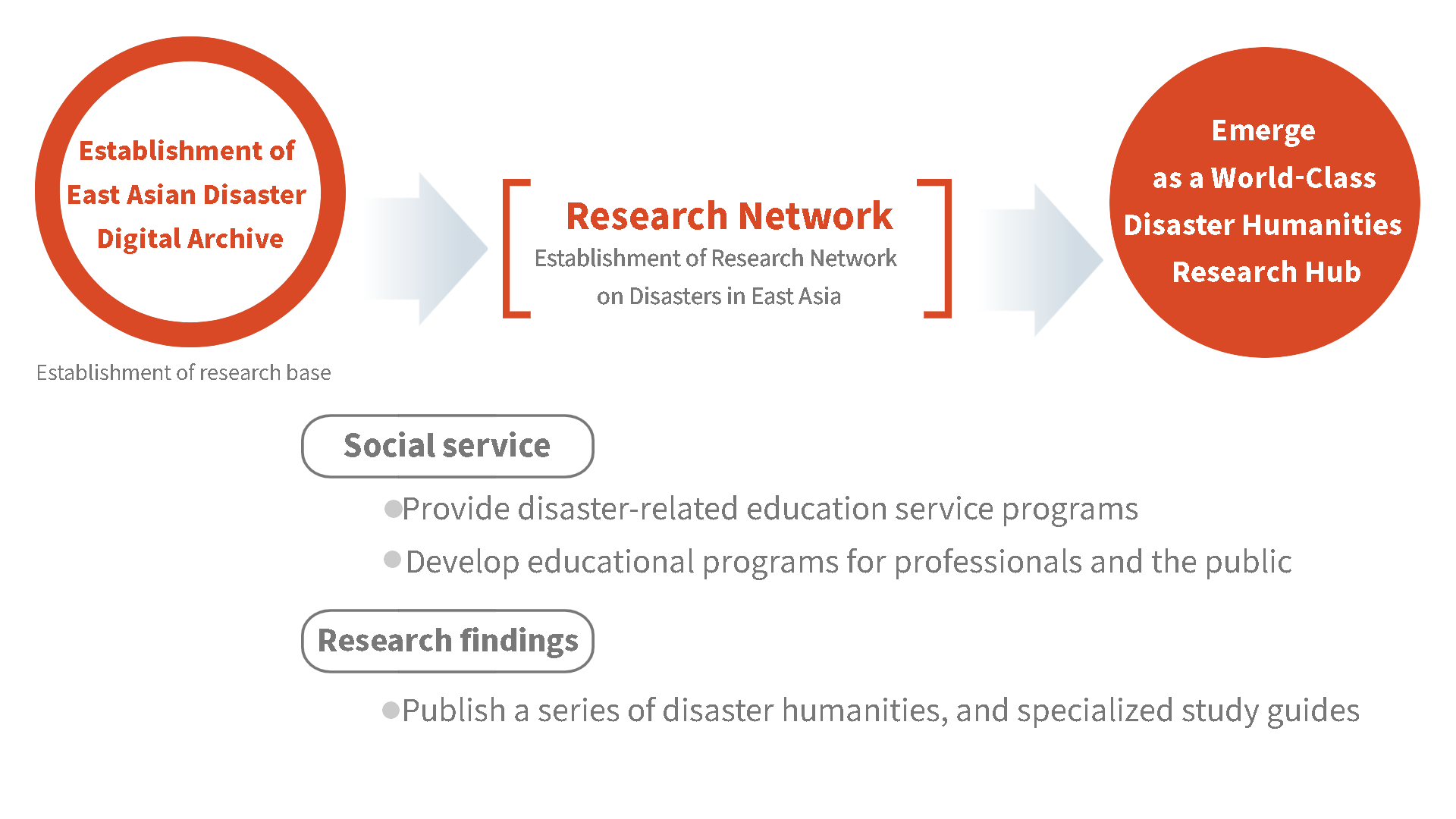
Our vision is to become a world-class research hub of Disaster Humanities by expanding the horizons of humanistic awareness on disasters and building a research network throughout East Asia.
Research Necessity and Importance
Research Agenda
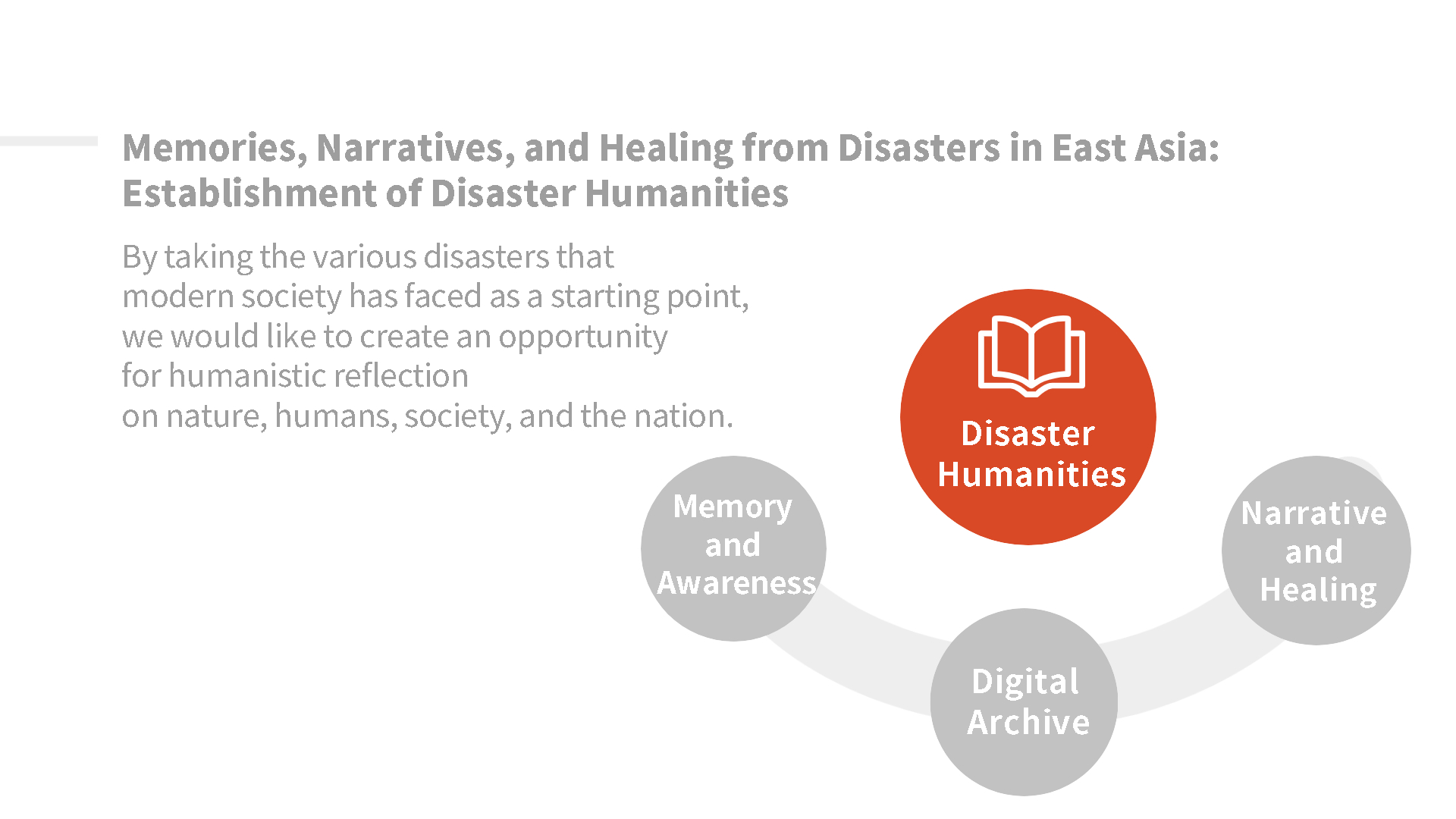
Memories, Narratives, and Healing of Disasters in East Asia: Establishment of Disaster Humanities
We now declare that life itself is already in a "disaster". Under this declaration, our intention in putting disasters on the agenda from the point of view of the humanities is not to belatedly think about ways to save us from disaster situations, or to find ways to cope with impending disasters. Rather, we make a request that the possibility of potential disasters prevalent in our society be detected in advance, and to contemplate such situations. Disasters have been around since ancient times, but it is no exaggeration to say that disasters became a major topic for the humanities in Korean society after the Sewol Ferry Disaster on April 16, 2014. The Sewol Ferry Disaster was a painful event which made us reflect on the values that have been denigrated and forgotten in the midst of rapid economic development and growth under a corrupt regime. While watching this calamity that should not have happened, we may have tacitly agreed to the existing order by avoiding the fundamental question through naming it a "disaster that typically occur in developing countries,” a perspective that only highlights the problems of the capitalist system as a whole.
The subject of research in disaster humanities includes events such as natural, social, and man-made disasters: floods, volcanoes, earthquakes, famine, war, genocide, terrorism, cholera, disease (epidemic), tsunami, the Fukushima Daiichi nuclear disaster, and climate change. One thing to keep in mind here is that the number of victims of human violence, such as wars, genocide, and terrorism, has been greater than that of natural disasters. In other words, just as we are accustomed to thinking that an infectious disease is caused by a germ entering the body from the outside, we often consider a catastrophe as a sudden attack of fear and terror from outside our reality. Yet more than a few disasters have been found to be the result of a contradiction or absurdity in reality that is exposed to the outside.
During the many disasters that have occurred in Korea since the 1990s, including the Sampoong Department Store collapse, the Seongsu Bridge collapse, the Yongsan tragedy, AI swine flu, MERS, and the Gyeongju and Pohang earthquakes, we focused on coping with the aftermath rather than thinking of and diagnosing the underlying problem of the events. We have never thought deeply about the disasters and the many questions they raised. In a reality where nightmares have become a part of daily life, it is evident that the root of the situation can no longer be completely solved with just a request to deal with the aftermath of disasters and sustain and manage society more safely. Disaster Humanities aims to create an opportunity even for late reflection and introspection on nature, humans, society and the nation, starting from the various disasters that Korean society has faced. By expanding the spatiotemporal scope to Korea, East Asia, and the world, we intend to lay the foundation for redesigning the blueprint and anthropology of a new society through insight into disasters.
Seven-year Research Plan
Memories, Narratives, and Healing of Disasters in East Asia: Establishment of Disaster Humanities
The seven-year research on disaster humanities will be conducted in two stages, with the first stage being "Reflection of the humanities on disasters" and the second "Establishment of a disaster humanities".
During the first three years (the first stage), it is planned to form a basis for studying disasters from a humanistic perspective. Disaster research trends at home and abroad will be determined, and disaster records of East Asian countries will be reviewed. An analysis of the causes and processes of disasters in East Asian countries, the awareness and memories of East Asians about disasters, and changes in identity, trauma, and mentality will be conducted. At this stage, it is planned to analyze how each country and society has responded to disasters and the changes after a disaster. A disaster itself affects human society, but political, social, and cultural changes occur through reflection on and response to disasters. In the second stage, responses to disasters and changes after disasters in East Asian society will be examined, and the interconnected relationship of East Asian disasters will be compared at the social, spatial, and time series levels.
To conduct this research in a systematic manner, a major topic was established for each stage and two keywords were set for each year. The goals for each stage and the keywords for each year are shown in the table below.
| Stage | Year | Keyword | Stage | Year | Keyword |
|---|---|---|---|---|---|
| Stage 1 : Humanities Reflection on Disaster |
1st | Recorded memory | Stage 2 : Establishment of Disaster Humanities |
4th | Religious rites |
| 2nd | Identity | 5th | Tech Media | ||
| 3rd | Traumatic mentality | 6th | Mobility/ Transboundary movement |
Memory and Awareness
Humans have no choice but to face disasters, including natural and man-made disasters, regardless of their intentions. Not only those who directly experience disasters, but also members of society who see such situations are bound to suffer the same wounds (traumas). How we remember and recognize such unavoidable disasters will change the way we respond to them.
Looking at the close relationship between "disaster," "humans" and "society," the study of disasters is found to fall under humanities research. Considering the profound impact disasters have on history and thought as well as on changes in social norms and structures, they can be said to be a key theme of the humanities. Understanding the interrelationships between disasters and humans, and how humans overcome them, solves long-standing challenges in the humanities, and at the same time settles social problems.
Narrative and Healing
The Narrative and Healing Team focuses on the narrative and healing aspects of disasters presented in oral records, and literary art works among the records of disasters in East Asian countries. Imagined image and representations in literature and art are a medium that can sensitively capture the flow of history while reflecting on reality from a distance. The Team examines how literary art texts have remembered and recorded disasters, and how such narrative works have had an influence on the formation of discourse on disaster healing.
Disasters change the way we recognize the world order or perceive the world. Disasters not only change our awareness of the world, but also the foundations and conditions of our emotions, sensations and imagination. The Team analyzes changes in the worldview and identities of those who have suffered a calamity in the work of narrating the experiences of disasters after disasters.
The commercialization of disasters is also critically reviewed by examining the ways in which disaster images are reproduced and consumed in art such as photographs, paintings, dramas, and movies that represent disasters. Furthermore, in the process of identification/de-identification due to disaster experiences, it is intended to seek solidarity with those who are incapacitated in disasters. In doing so, we try to draw a point where the term disaster can be used in a new context, and to secure the possibility of using disaster for other purposes. The process of ruminating over and transforming the experiences of war and massacre into various narratives is related to the crisis of the minds and hearts of people who have been through the socio-cultural situation surrounding disasters. Therefore, continuous changes in the dominant mentalities of individuals and groups after disasters are studied. The trauma and change of mind left by historical events on individuals and communities is noted, including the Japanese occupation, the Jeju 4·3 Incident, the Korean War, the Gwangju massacre, the Tiananmen Square Massacre and the Great East Japan Earthquake, as well as wounds caused by war, infectious diseases, and famine.
Modern catastrophes are disseminated through the media. The attitudes and methods taken by press and media coverage at the time of and after a disaster in reporting on the disaster are examined from an ethical point of view. Through an analysis of rumors, hoaxes, and online media, it is possible to understand the process of forming public opinion after a disaster and the point at which a disaster becomes an incident.
In a post-disaster society, various safety measures are prepared under the cause of protecting and managing human life and society. We will examine the solidarity of governance and safety measures that control and manage human lives and everyday living after disasters, and governance strategy related to measures for maintaining public safety and social order.
Today, disasters are not limited to the territory of one country, but threaten East Asia, and furthermore even the entire planet. Since the 20th century, disasters have developed on a global scale. Therefore, we will focus on “moving disasters” and “mobility of disasters” and consider how East Asian societies can jointly respond to the problems of refugees and diasporas caused by disasters.
Digital Archive
Disaster research requires a convergence methodology based on humanistic problem recognition and perspective, social science research methodology, and scientific data understanding. To this end, joint research is conducted with relevant branches of study, and data materials are exchanged and shared with domestic and foreign researchers and research groups to establish a mutually connected digital archive. The digital archive forms a digital-based research environment that can explore social interconnections by accumulating a database of disaster-related records and memory information contained in various East Asian materials. Based on the digital research methodology of the humanities, we attempt to archive natural disasters related to nature, environment, climate, and diseases that occurred in East Asia from ancient times to the present, as well as man-made social disasters such as riots, conflicts, and wars, and their records. In this way, the limitations of individual offline research will be overcome, and the digital research methodology of the humanities will be introduced in a collective and collaborative way. Ultimately, we aim to build a comprehensive archive of memories, records, and narratives related to various disasters.